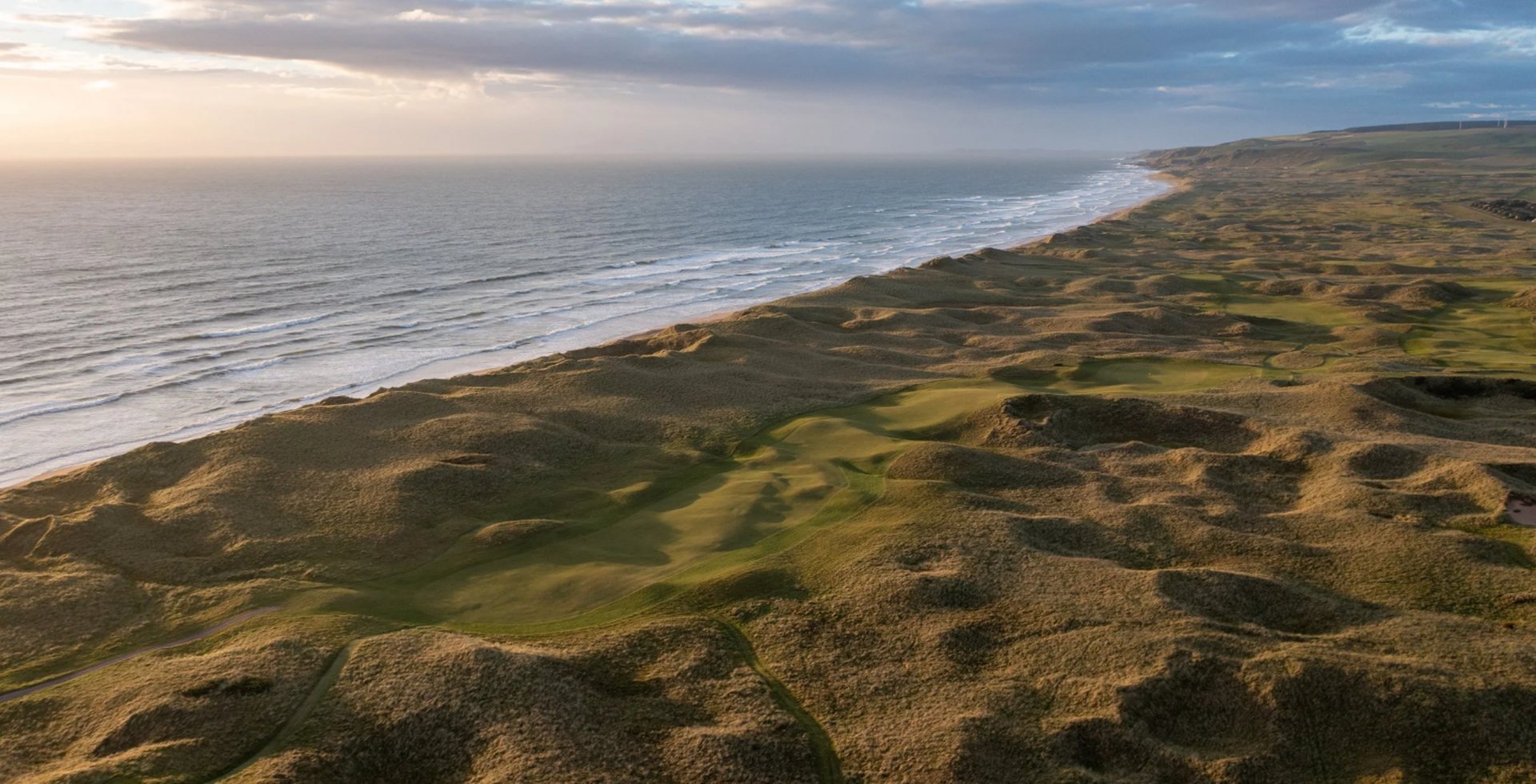
About Machrihanish Golf Club Championship Course
Machrihanish Golf Club course is an 18-hole traditional out-and-back links beside Machrihanish Beach on the Kintyre peninsula. Its opening drive crosses the beach’s corner, while natural dunes, Machrihanish Burn and the long middle stretch called “the gauntlet” shape a course of unusual geography.
Flyover of the course
@machgolf
Key Features & Highlights
• The first tee requires a shot over the corner of Machrihanish Beach before play enters the dune ground above the bay.
• Machrihanish Burn creates a clear physical division between the lower holes at the beginning and end and the principal course route.
• The third hole plays towards the ocean, with Jura identified by the club as the backdrop beyond the course.
• Holes five to nine are known by the club as “the gauntlet”, a named five-hole passage where accuracy is emphasised.
• The traditional out-and-back layout sits on natural dunes beside Machrihanish Bay on the Kintyre peninsula.
Course Overview
A first shot drawn across the beach
The Machrihanish Golf Club course begins at the edge of Machrihanish Beach, where the opening tee shot is played over a corner of the sand before the round moves into the dunes above Machrihanish Bay. It is a precise, visible fact rather than a piece of golfing folklore, and it immediately explains why this 18-hole Championship Course has such a strong visual identity. The beach is not distant scenery; it occupies the line of play from the first tee.
Machrihanish lies on the Kintyre peninsula, close to Campbeltown, in a part of western Scotland where the land runs out towards the Atlantic-facing bay. The club presents its Championship Course as a traditional out-and-back links, laid through natural dunes and overlooking the water. That arrangement matters. Rather than following a parkland route with woodland boundaries or constructed lakes, the course takes its form from sandy ground, open space and the shore.
The Old Tom Morris attribution at Machrihanish
The club attributes the Championship Course to Old Tom Morris, placing Machrihanish within the long nineteenth-century story of Scottish links golf. Care is needed with any historic design credit: the supplied club information confirms the Morris attribution, but does not set out the original date of construction, later extensions or alterations. What its Championship Course page does state is that the links has remained largely unaltered, a description that directs attention to the land itself rather than to a modern architectural intervention.
That claim is most easily understood in the continuity of the terrain. Dunes remain the course’s principal feature, with golf holes fitted among their rises and hollows. The bay supplies the broad horizon, while the beach appears at the outset as a physical part of the task. It is a different proposition from a course that merely looks towards the sea from an elevated point: at Machrihanish, shore, sand and playing ground meet without much separation.
The source material does not provide verified detail on green contours, bunker construction, prevailing wind, par, yardage or course rating. Those omissions are worth observing for travellers who choose courses through architectural detail or scorecard measurements. Machrihanish can be described confidently as an Old Tom Morris-attributed links of natural dunes; finer claims about its playing surfaces or the precise demands of individual shots would need fuller course documentation.
How the Championship Course unfolds
After the first, the early holes establish an important division in the site. Machrihanish Burn separates holes 1, 17 and 18, which sit on lower ground, from the main body of the course. This is not merely a map reference. The burn gives the route a clear geographic threshold: the round leaves the lower opening ground behind, then returns to it for its final two holes.
The third turns the player’s attention towards the ocean. The club identifies Jura as the backdrop from this hole, bringing another of Scotland’s western isles into the view beyond the playing ground. It is a useful point of orientation in a round that otherwise takes place among dune forms rather than beside conspicuous buildings or inland landmarks.
From the fifth through the ninth, the club applies a specific name: “the gauntlet.” The phrase identifies a five-hole section in which accuracy is the stated requirement. It gives the front nine a recognisable middle chapter, rather than treating all of its dune holes as interchangeable. For a visitor, it is also a practical marker in the round: the fifth tee begins a defined stretch that should be approached with attention to placement rather than as a sequence to be hurried through.
The closing route brings Machrihanish Burn back into view through the placement of the 17th and 18th. The supplied information does not describe the individual hazards, targets or green approaches on these holes, so it would be speculative to prescribe a strategy. What can be said is that the course finishes where it began geographically, on the lower side of the burn, giving the out-and-back arrangement a tangible conclusion.
A links shaped by its bay
Machrihanish Bay is the constant setting of the Championship Course, but the course’s interest lies in the way particular features interrupt and direct the round. The beach makes an immediate appearance at the first; the burn divides the lower holes from the rest; the third frames a view towards Jura; and the dunes provide the ground through which the principal route runs. These are discrete landmarks, each attached to a known point in the round.
The club’s own description uses the terms remote and rugged for the course. For a golf traveller, “remote” is best read as a planning consideration as well as a mood. Machrihanish is on Kintyre rather than in Scotland’s densely linked east-coast golf corridor, so a visit benefits from deliberate itinerary planning. Its value is in the concentration of place: a course beside a named beach and bay, with the Peninsula’s western geography visible in the round.
There is no verified evidence in the supplied material for claims about weather patterns, walking ease, pace of play or day-to-day course conditions. Those are variables worth confirming directly before travel, particularly for golfers organising fixed tee times or onward journeys. The enduring facts are more useful than assumptions: this is an exposed coastal landscape formed by dunes, watercourses and beachside ground.
Arrival and practical planning for Machrihanish
The club lists a clubhouse and professional shop among its facilities. That offers a straightforward starting point for the visitor journey, though the available information does not support further statements about dining, practice areas, locker rooms, caddie arrangements or accommodation. Travellers who require those services should establish current availability before finalising a schedule.
The Championship Course has three published seasonal bands. High season runs from April to September, mid-season covers March and October, and low season falls between November and February. No green-fee figures were supplied, so it would be inaccurate to suggest an expected price or to imply that a particular period offers better value. The seasonal structure does, however, give overseas groups a clear framework for checking dates and availability.
The club’s official “Championship Course” page is the source for the course layout, Morris attribution, beach opening, burn, Jura view and “gauntlet” terminology. Its main club and green-fee pages are the appropriate sources for current visitor arrangements and seasonal booking information. Details that change regularly, including tee-time availability, should be confirmed through those official channels.
Who will value the journey
Machrihanish rewards golfers who choose a course for its relationship with a particular piece of Scottish coast. The central appeal is not a catalogue of manufactured features, nor an unsupported promise about how a round will play on any given day. It is a traditional links route whose defining elements can be named exactly: a drive over the beach’s corner, dunes above Machrihanish Bay, a burn that divides the course, a third-hole sightline to Jura, and the accuracy-focused run from the fifth to the ninth.
For those building a Kintyre itinerary, the Championship Course offers a direct encounter with the terrain that has shaped its reputation. Begin with the club’s official seasonal information, allow sufficient time for the peninsula journey, and let the course’s documented landmarks provide the structure for the day.
History & Heritage
Heritage
Machrihanish Golf Club identifies its Championship Course with Old Tom Morris, one of the central figures in nineteenth-century Scottish golf. The club’s official Championship Course material also characterises the links as largely unaltered, linking its present route closely to the natural dune ground above Machrihanish Bay.
The available club information does not provide a verified founding year, original construction date or account of subsequent design work. It is therefore more accurate to describe the course as attributed by the club to Old Tom Morris than to make unqualified claims about every stage of its architectural history. Its heritage is visible in the enduring links setting: beach, burn, dunes and open bay remain the elements that organise the round.
Insider Tips & Visitor Information
1. Seasonal Dates: The club categorises April through September as high season, March and October as mid-season, and November through February as low season: Use those published periods as a first guide when comparing possible travel dates, then check current tee-time availability directly with the club.
2. Allow For Kintyre: Machrihanish sits on the Kintyre peninsula near Campbeltown rather than within Scotland’s most concentrated golf districts: Build the journey into the itinerary rather than treating the round as a quick diversion between more central destinations.
3. Study The Route: The official Championship Course information identifies a beach carry at the first, the burn around holes one, 17 and 18, and the accuracy-focused fifth-to-ninth stretch: Reviewing that route before play gives useful context without relying on unverified hole-by-hole advice.
4. Confirm Facilities: The supplied club information lists a clubhouse and professional shop: It does not verify practice facilities, dining arrangements, caddie services, changing rooms or accommodation, so groups needing particular services should confirm them before committing to travel plans.
Machrihanish on a calm day
@machgolf
